

Seven Churches & Istanbul
Visit the Cities of the Seven Churches in Revelation
8 Days | Year Round
Starting At $CUSTOM
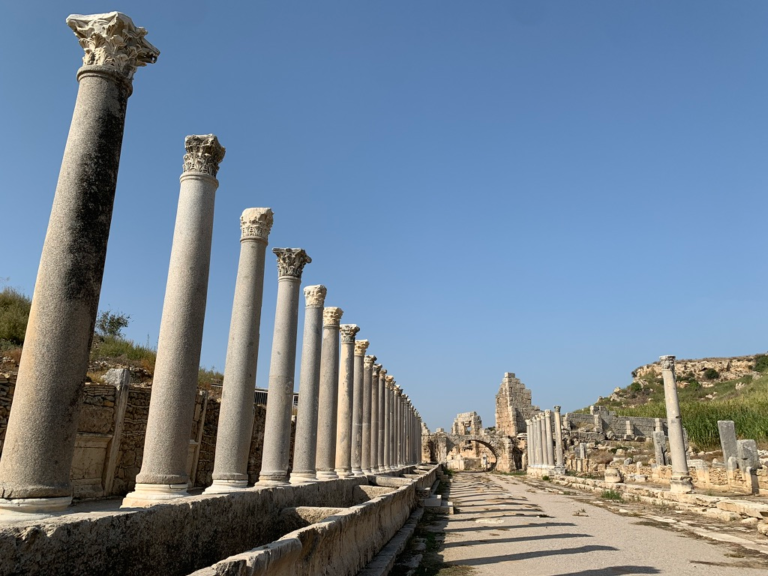
All seven churches of Revelation 1–3 — Ephesus, Smyrna, Pergamum, Thyatira, Sardis, Philadelphia, Laodicea — framed by two different İstanbul’s: the Asian shore and the Princes’ Islands to land softly, the guided Old City to finish.
Highlights
Tour Highlights:
|
Tour Inclusions:
|
This trip is perfect for a small group! Can operate with as little as 10 passengers!
Add on a 3 day Cappadocia Extension, ask your U S Tours Sales Representative for more information.
Itinerary
Day 1 – Arrive Istanbul
Meet your tour guide at the airport. Transfer to your hotel in Kadikoy – ancient Chalcedon, on the Asian shore. Enjoy a welcome dinner with your group & take the evening to settle in. (D)
Day 2 – Istanbul – The Princes’ Islands
After breakfast, enjoy a gentle day on the water before the road: ferry from Kadikoy across the Sea of Marmara to the car-free Princes’ Islands. They evolved from a place of exile during the Byzantine era, to a popular destination for tourists and Istanbulites alike to escape the hectic city life for a day. Of those nine islands, only four of them are open to the public. The main feature of any of the Princes’ Islands is the sound of … silence. All fuel-driven vehicles are banned, making the islands an oasis of peace and quiet. The main transportation means are bicycles, electric buses, and electric taxis.The only sounds you’ll hear are bicycle bells and footsteps. But that’s not the only feature that makes the Princes’ Islands unique. You’ll find yourself walking or riding through narrow streets flanked by either untouched pine forests or fine, wooden Victorian cottages.
Ferry back for free time in Kadikoy market streets. Enjoy dinner together this evening. (B,L,D)
Day 3 – Pergamum, Smyrna, & Sirince
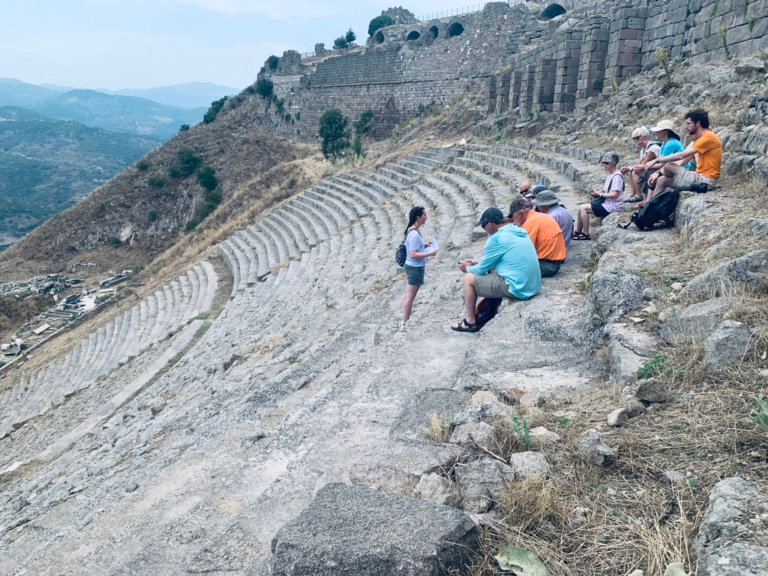
Depart this morning and head south. The first stop is at Pergamum: — the church in which John claims is the “throne of Satan” (Revelation 2:12-13). Visit the acropolis, its theater, and the altar site. Continue to Smyrna (İzmir): the excavated agora at the heart of the modern city. The agora was the center of life in ancient Smyrna. It was built in the 3rd century BC during the Hellenistic period but destroyed in 178 by an earthquake. It was rebuilt shortly after under Roman emperor Marcus Aurelius. The Smyrna Agora was abandoned after the 7th century and later used as a cemetery. Excavations began in 1933 and are still ongoing. This evening you will arrive in Şirince, a stone-built hillside village near Selçuk. Overnight in Sirince. (B,L,D)
Day 4 – Ephesus – Laodicea
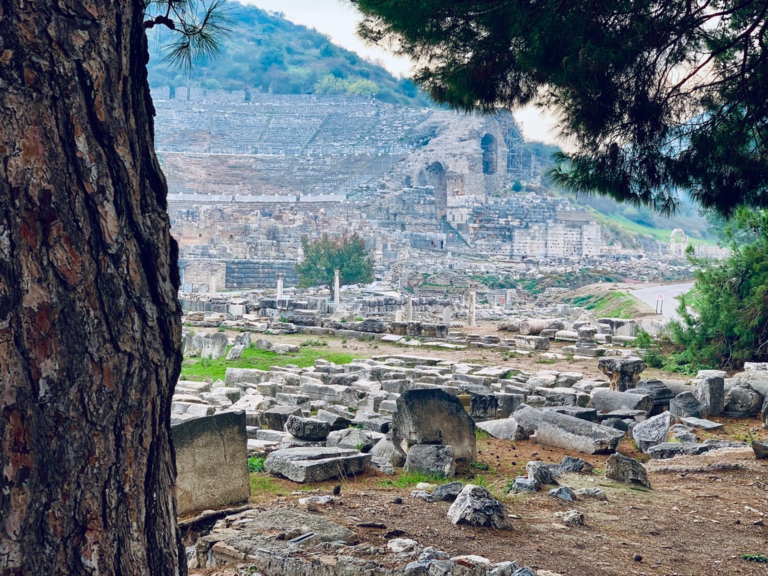
A full morning is planned in Ephesus: First, the theater of Acts 19. Cut into the flank of Mount Pion where the harbor avenue meets the marble street, the theater began as a Hellenistic building of the third century BC and was progressively enlarged under the Roman emperors into the giant that stands today: three tiers of twenty-two rows each, seating an estimated twenty-five thousand people — one of the largest outdoor auditoriums of the ancient world. Its stage building rose some eighteen meters, a marble cliff of columns, niches and statues; its gates sorted the classes of Ephesian society to their proper rows. The scene rewards a slow reading on site. Paul wants to enter and face the crowd; the disciples and even friendly provincial officials beg him not to (Acts 19:30–31). Most of the crowd “knew not wherefore they were come together” (19:32) — the most honest description of mob dynamics ever written. And it ends not with a miracle but with a civil servant: the town clerk’s masterly speech about courts, proconsuls and lawful assemblies (19:35–41), delivered from a stage whose foundations still stand.
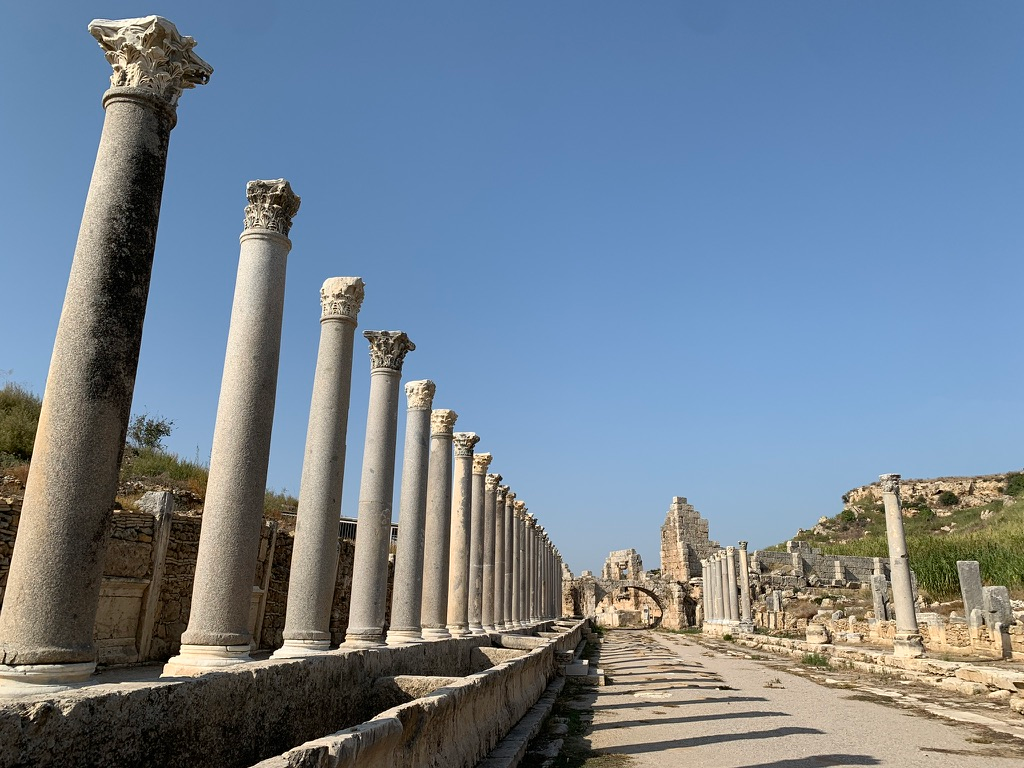
Later, visit the Library of Celsus, and the marble streets Paul knew. Between 12,000 and 15,000 scrolls were kept in the Library of Celsus — enough to make it the third greatest library of the ancient world, behind only Alexandria and Pergamon. But the building is stranger and more touching than a library: it is also a tomb. Celsus Polemaeanus was a local success story on an imperial scale: a Greek from Asia Minor who rose through the Roman Senate to govern the very province he came from. When he died, his son, Tiberius Julius Aquila Polemaeanus, began this library as his father’s memorial, starting around AD 110. Roman law kept burials outside the city walls — but for Celsus an exception was granted, and he was laid in a lead coffin inside a marble sarcophagus, in a vault beneath the ground floor. Readers upstairs, founder below: the most dignified permanent residency in history.
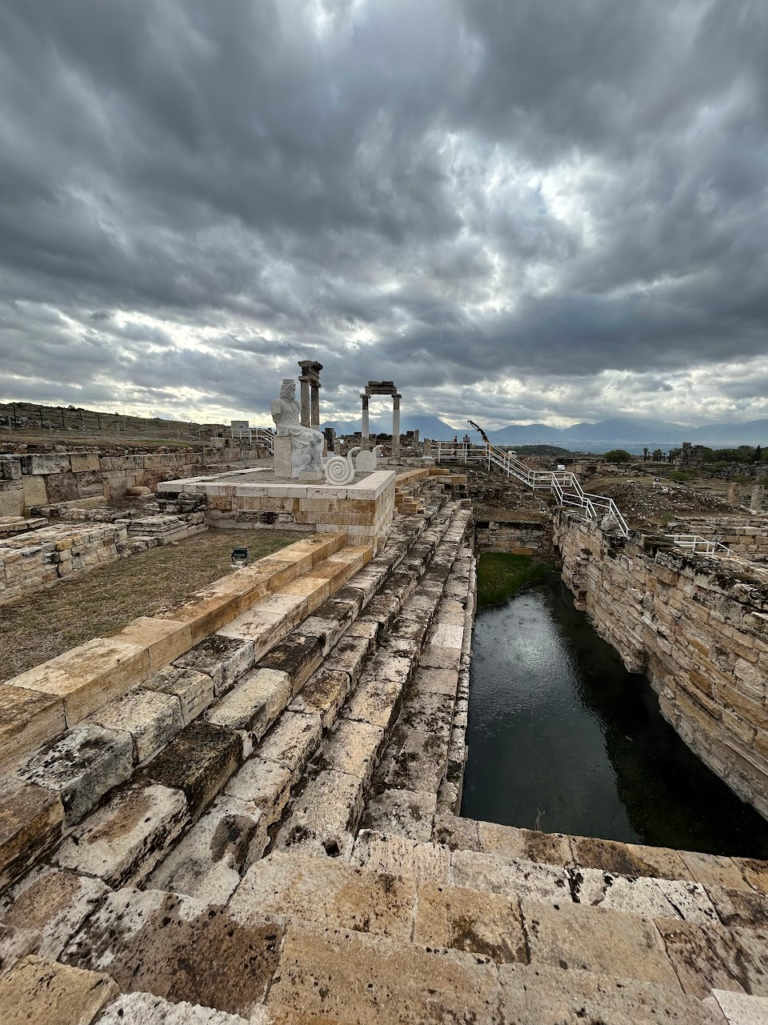
After lunch, take the drive inland to Laodicea — the lukewarm church, and the aqueduct that explains the letter. The church of Laodicea is the last of seven churches addressed in Revelation. This harsh pronouncement suggests that the Christians at Laodicea wavered in their commitments to the Christian faith. Laodicea was a wealthy city during the Roman period. Not only was Laodicea located on major trade routes that connected it to important cities like Ephesus, Smyrna and Sardis, but also it was a center of textile production and banking. Perhaps not surprisingly, the church of Laodicea is noted as being wealthy in the Bible (see Revelation 3:17). Overnight in Denizli.
Day 5 – Hierapolis & Pamukkale – Philadelphia – Sardis
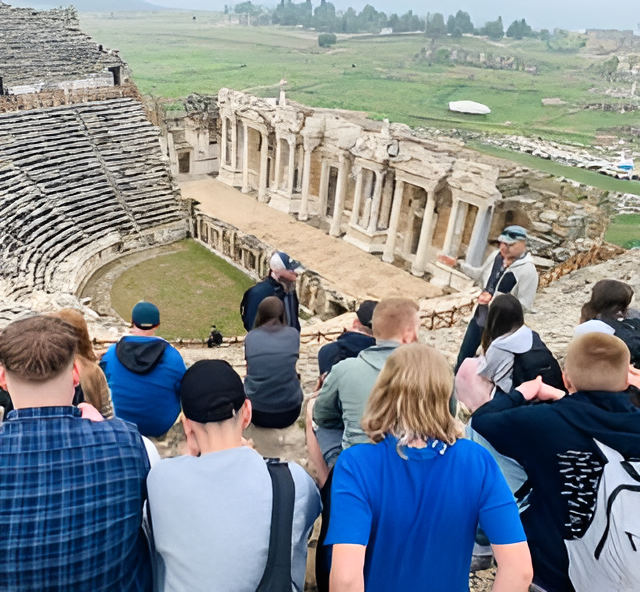
Inscribed by UNESCO in 1988 as a mixed natural and cultural World Heritage Site — combines two distinct outstanding universal values on a single spectacular hillside above the Çürüksu valley in Denizli Province, southwestern Turkey: the Hellenistic-Roman spa city of Hierapolis (founded circa 190 BCE, populated through the Byzantine period until an earthquake destroyed much of the city in 1354 CE) and the Pamukkale travertine terraces (the “Cotton Castle”), a 160-metre limestone cliff covered in an extraordinary deposit of white calcium carbonate left by thermal mineral springs. The Sacred Pool (Antique Pool, Kleopatra’s Pool) within the Hierapolis archaeological zone is a thermal spring pool where ancient architectural elements — column drums, Corinthian capitals, architectural blocks — lie scattered on the pool floor, visible through the warm clear mineral water: the pool is now operated as a swimming attraction, allowing visitors to bathe in the same thermal water that ancient Romans bathed in, amid the submerged remains of the colonnaded building (possibly a Roman bath-gymnasium) that was demolished in the 7th-century CE earthquake.
After your visit, continue on to Philadelphia – the church with the open door. Philadelphia was not a powerful city. The church there had, in the words of the letter, “little strength.” But it had kept Christ’s word and had not denied his name. For that faithfulness it received one of the most generous promises in all of Revelation: an open door no one can shut, protection through the hour of trial, and a place as a pillar in the temple of God. The main remains are several tall brick piers from a Byzantine basilica dedicated to St. John, dated to around the sixth century. They rise out of an excavated area in the middle of town, with fragments of fresco still clinging to the brick in places. These pillars are the natural gathering point for a group. There is a quiet symmetry in reading a letter that promises the faithful will become pillars in God’s temple while standing beneath the literal pillars that outlasted the city around them.
After lunch, continue your afternoon at Sardis. Sardis was the capital of the kingdom of Lydia, the city of King Croesus and of the first gold and silver coins in history, struck here around 600 BC from the gold of the Pactolus stream. Conquered by Cyrus the Great in 547 BC, it became the western terminus of the Persian Royal Road, then a Hellenistic and Roman metropolis and the fifth of the Seven Churches of Revelation. Excavated by Princeton (1910–14) and since 1958 by the Harvard–Cornell expedition, Sardis today offers two spectacular and quite separate areas: the Temple of Artemis beneath the jagged acropolis, and the restored Roman bath-gymnasium complex with the largest ancient synagogue ever found, lined with marble and mosaic. It lies on the İzmir–Pamukkale road and is one of the most rewarding stops on the Aegean. This afternoon enjoy visits to the riuns of the gymnasium, the great synagogue, and the Temple of Artemis. Overnight in Sardis. (B,L,D)
Day 6 – Thyatira – Istanbul
This morning visit Thyatira (Akhisar), hometown of Lydia the seller of purple — completing all seven churches. Thyatira may appear modest at first glance, but beneath its unassuming surface lies centuries of history and faith. Once a bustling trade center of the ancient world, it is remembered as one of the seven churches praised for its love and perseverance but warned against false teachings. Today, only a few columns and remnants of ancient walls mark the heart of the city, yet standing among them, you can feel the deep sense of continuity between past and present. The simplicity of the site allows you to reflect on its Biblical significance without distraction. Unlike grand archaeological sites such as Ephesus or Pergamon, Thyatira offers something more intimate – a glimpse into the life of an early Christian community that thrived amid commerce and culture. Surrounded by the everyday rhythms of Akhisar, it’s easy to imagine the city’s former vibrancy, where traders, artisans, and believers once filled the streets. Thyatira provides a quiet yet powerful stop.
Return to Istanbul this afternoon with a lunch stop en route. Overnight in Istanbul, with your hotel being steps away from the Old City. (B,L,D)
Day 7 – Istanbul – The Old City
Enjoy a fun filled day in the Old City. A morning packed with visits starting with the Hagia Sophia. The Hagia Sophia is an enormous architectural marvel in Istanbul, Turkey, that was originally built as a Christian basilica nearly 1,500 years ago. Much like the Eiffel Tower in Paris or the Parthenon in Athens, the Hagia Sophia is a long-enduring symbol of the cosmopolitan city. However, as notable as the structure is itself, its role in the history of Istanbul—and, for that matter, the world—is also significant and touches upon matters related to international politics, religion, art and architecture. The Hagia Sophia anchors the Old City of Istanbul and has served for centuries as a landmark for both Orthodox Christians and Muslims, as its significance has shifted with that of the dominant culture in the Turkish city.
Behind the Hagia Sophia sets the Hippodrome. The Hippodrome of Constantinople (today Sultanahmet Square) was the center of social life in the Byzantine Empires for centuries. The Hippodrome, where relentless chariot races were held, was also the scene of many rebellions and massacres. Roman Emperor Septimius Severus built the first version of the structure around the year 203. He aimed to develop the city under the name “Novaroma” to rival the Italian capital. In the 4th century, Constantine the Great expanded the Hippodrome to gigantic proportions. He designed a stadium that measured 400 meters in length and 117 meters in width. This area could hold up to 70,000 screaming spectators. Constantine transformed the city into the new capital of the Eastern Roman Empire. By doing so, he attracted the full attention of the world to this massive sports arena.
Before lunch, your last two stops will be the Basilica Cistern, and the Topkapı Palace courtyard. The Basilica Cistern is the largest of several hundred ancient cistners that lie beneath the city of Istanbul. The cistern, located just southwest of the Hagia Sophia, was built in the 6th century during the reign of Emperor Justinian I.
Topkapi Palace is a large museum and library in the east of the Faith District in Istanbul. From the 1460s to the completion of Dolmabahce Palace in 1853, it served as the administrative center of the Ottoman Empire, and was the main residence of its Sultans. The palace complex has hundreds of rooms and chambers, but only the most important are accessible to the public as of 2020, including the Ottoman Imperial Harem and the treasury, called hazine where the Spoonmakers Diamond and the Topkapi Dagger are on display. The museum collection also includes Ottoman clothing, weapons, armor, religious relics, and illuminated manuscripts.
After a full morning of touring, enjoy lunch together before free time to shop the Grand Bazaar. Dinner this evening is on your own. (B,L)
Day 8 – Depart for Home
Transfer to the Istanbul Airport for your flight home.